
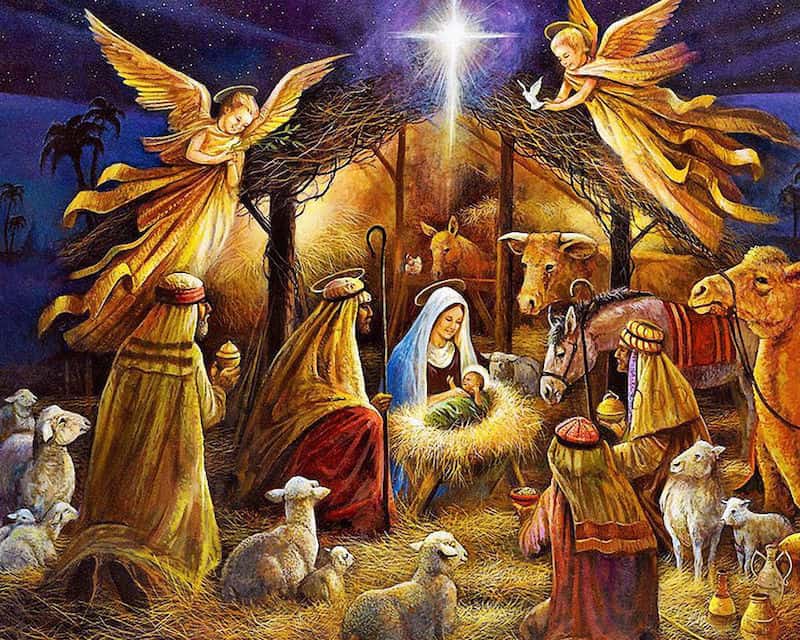
No one knows the real birthday of Jesus. But one thing is for sure. It is not on December 25. Several facts point to the actual birth of Jesus taking place in September or October.
Let us look at the facts. At the time of the birth of Jesus, when that big new star was shining in the night sky, shepherds were out in the fields, watching their flocks by night. Shepherds were able to keep their flocks of sheep out in the fields day and night during the summer and into the early fall months, until the rainy season began. They went by the Jewish months in the Torah. The rainy season was called Heshvan, in what is now fall. When the winter months arrived, it was too cold with frost and snow to keep the sheep out in the fields. Shepherds were not out in the fields during the winter.
Remember that the reason for Mary and Joseph to go to Bethlehem was to register for the census. It was the first registration of people of the earth of its kind. Caesar Augustus sent out a decree for all the inhabited earth to be registered. Even the Syrian Governor Quirinius was interested in the outcome. Everyone belonging to the house of David had to register in Bethlehem. This census would not have taken place in the winter when the roads would have been treacherous with ice and snow.
So why was the celebration of the birth of Jesus moved to December 25?
At the time of the decision to put the birth of Jesus on December 25, (the Iranian god Mithras’s (their sun god) birthday was on December 25, established by none other than Nimrod of Babylonian fame); the Roman Empire was in charge. Nimrod and Ishtar, who self-dubbed herself as “Semiramis, Goddess of the Moon.” They created popular new customs that became instantly popular, like cutting down evergreen trees and decorating them with silver and gold ornaments, putting up wreaths and mistletoe, and Yule logs. Sound familiar?
People did not want to give up these popular customs, which also included celebrating the god of sowing and harvest, Saturn, which was celebrated on December 17 (in today’s calendar). Nimrod expanded the celebrating time between December 17-25 as a time of unbridled revelry, anything goes, wild parties, drunken orgies, and decadent food.
When the Roman government wanted to rule over the entire world, it was decided to put the celebration of the birth of Jesus on Mithras’s feast day, December 25, as a way to entice new Christians to switch over to belief in Jesus, instead of celebrating Mithras as the “Sun god.” They thought they could trade the “Sun god,” for the “Son God.” However, all of the customs and traditions that celebrate the false, man-made god Mithras (man-made by Nimrod and Ishtar), remain to this day.
All of the other religious holiday traditions likewise replaced secular feast days and celebrations, like the Spring and Fall Equinoxes and the Summer and Winter Solstice celebrations.
Many Christians today are taking a closer look at Christmas as the “reason” to celebrate the birth of Jesus. If Christians truly believe that Jesus is the “reason for the season,” then we ought to be celebrating the birth of Jesus when he was actually born, in September or October, not on a false, pagan god holiday, complete with all of the false God’s customs and traditions, on December 25.
Have you ever asked yourself why there are so many Roman Catholic Churches in every city and state in the world?
There is much that has been misunderstood about the life of Jesus, including what has been neatly carved out of modern bibles, which does appear in the hidden scriptures found at Nag Hammadi and the Dead Sea Scrolls. The Books of Enoch hold such pearls from which even Jesus has quoted.
There is so much more for us to know that the convenient stories that have repeated on an infinity loop since what has been taught since sixth grade.
God Bless Everyone Everywhere
No ancient source connects Mithras to 25 Dec tho. Nor does any ancient source indicate official involvement in setting the date of Xmas. It just appears in 336 in the Chronography of 354 in a list of martyrs’ days. Nobody knows why.
Thank you for visiting this blog Roger.
Many solar deities were flourishing in the Middle East, Mediterranean and Europe prior to the days of Jesus and Christianity. In Rome, Mithra (or Mithras) worship was the predominant religion. Mithra was originally the Vedic God Mitra, one of the twelve Adityas of the Rig Veda, the worship of whom reached Rome through Persia, Asia Minor and Syria. He was the symbol of friendship, light, transparency, and justice, because he used to be invoked in various treaties. In Persia he was called Mithra. There his birthday became December 25 and the festival of ShabeYaldaa was his birthday celebration. The ancient Greek historian Herodotus (nearly 2500yrs ago) mentions this festival was the biggest in Persia at that time. In the Zoroastrian religion, Mithra was considered as the mediator between the highest God Ahura Mazda and humanity.
It was believed Mithra would lead the dead to heaven, resurrect the dead, will judge the humanity on the last day of the world etc. (His role as the judge on the last day comes from Zoroastrian faith as Hindus have no day of judgment). Mithra worship was present in the Middle East at least 3000 years ago as can be seen from the famous Hittite-Mittiani treaty in which he is invoked. In Syria Mithraism arrived well before the turn of the Common Era (AD/CE).
The counter part of Julius Caesar in Syria was Mithradetus (meaning the justice of Mithra). It was believed that the Syrian sea pirates brought Mithra worship into Rome. In Rome he underwent further transformation. Mithras was born on December 25 by emerging from a rock (born of the virgin- Earth), a birth attended by shepherds. As an adult, he hunted for a sacred bull, captured, and dragged it into a cave where he slayed it with a short sword. They thought from the bull’s blood and semen arose grain (also attributed to the god Saturn) and the general vitality of nature. An inscription in the Santa Prisca Mithraeum on the Aventine in Rome says, “You saved us by shedding the eternal blood.” (Of course, the blood was of the bull; not of Mithra). There is not enough extant literature about Roman Mithraism, most likely because the church would have destroyed them when it got power.
Almost all we know today is based on the interpretation by modern scholars from reliefs, sculptures, and paintings on surviving monuments, mostly in the Mithraea (Mithraic sanctuaries). Mithraism reigned in Rome for about five centuries ending in the 4th century CE. Several hundred Mithraic monuments were found in Rome (Coarelli, 1979). Adapted for Roman taste, the most popular Romanized form of Mithraism was Sol Invictus, the Unconquerable Sun, whose re-birth was celebrated as the climax of the mid-winter Saturnalia, on December 25. Saturnalia honored the “good old days” when the god Saturn ruled a supposed “Golden Age”, and there were no masters and no slaves, and everything was easy.
The pagan celebration of Saturnalia first began as a harvest and agriculture celebration on December 17, to give thanks to the god Saturn. With the popularity of the Mithra celebrations, the revelry of Saturnalia was decided to be extended through December 25, and later through the New Year in the Gregorian Calendar.
For the first three centuries of Christianity’s existence, the birth of Jesus Christ was not celebrated at all. The Christian religion’s most significant holidays were Epiphany on January 6, which commemorated the arrival of the Magi after Jesus’ birth, and Easter, which celebrated Jesus’ resurrection. The first official mention of December 25 as a holiday honoring Jesus’ birthday appears in an early Roman calendar from 336 A.D. Notice this is also around the time when the popular pagan Mithra celebrations of feasting, frolicking, orgies and in some cases, murder took place.
Remember in 2 Kings 17:17 that this was at the time they had child sacrifice, as if sacrificing their first-born children in the fires in the pagan, ziggurat temple could possibly take away their sins or could be used as a bargaining chip for good fortune for themselves.
That is when it was decided to extend the celebration, from December 17, the feast day honoring the god Saturn, who they revered since they thought Saturn brought them a bountiful harvest, and combine the revelry past December 25, the pagan feast day of Mithra, the god of light, and into the New Year.
The bible does not mention Jesus’ exact birthday, and the Nativity story contains conflicting clues. For instance, the presence of shepherds and their sheep suggest a spring or fall birth. When church officials settled on December 25 at the end of the third century, they likely wanted the date to coincide with existing pagan festivals honoring Saturn (the Roman god of agriculture) on December 17, and Mithra (the Persian god of light) on his birthday which was celebrated between December 22 and 25, placed on the shortest, darkest day of the year, the Winter Solstice. That way, it became easier to convince Rome’s pagan subjects to accept Christianity as the empire’s official religion. They could then celebrate the Son God rather than the Sun god.
Some, including the Puritans of colonial New England, even banned its observance of Christmas because they viewed its traditions—the offering of gifts and decorating trees, for example—as linked to paganism. Check out Jeremiah 10:1-4. Here we have the first biblical account of cutting down “Christmas” trees, nailing them up so they do not fall over in their homes, and decorating them with ornaments of silver and gold. Jeremiah 10:5-10 talks about the pagan Winter Solstice celebrations as idols and how they cannot replace the One, True God. Jeremiah 7:18 condemns the pagan practice of baking cakes for the queen of heaven.
The pagan Emperor Constantine worshiped the sun god Mithra. Constantine is the one who decided to put the birth of Jesus Christ on December 25. Constantine only became a Christian on his deathbed. Roman pontiffs followed Constantine’s lead in 354 AD. Bishop Liberius of Rome ordered the people to celebrate on December 25. We see the mixing of the good seed with the bad, or pagan and Christian worshipping a god and The God of all Creation on the same day, in this example.
In the early days of the United States, celebrating Christmas was considered a British custom and fell out of style following the American Revolution. It was not until 1870 that Christmas became a federal holiday.
I hope knowing this accurate history helps.
Peace and Joy, Lin
Many thanks for your reply, Lin. I think it’s only fair to reference all those words, tho: this is word-for-word from D.M. Murdock, or Acharya S as she then called herself, “Was Mithra born of a virgin mother?” Poor woman, she’s dead now, isn’t she: died on 25th December too. Of course she wasn’t a historian but a crank. Sadly very little of this is true.
For instance since 1971 it has been understood that Persian Mithra and Roman Mithras are different deities. May I recommend the standard university textbook, Manfred Clauss, “The Roman cult of Mithras”, translated from the German and published by Oxford? I think you will still find in the sadly vandalised Wikipedia article a statement that the association of Mithras with 25 Dec is “the hoariest” of falsehoods. There is no ancient evidence of it: it was a bit of speculation by the great Franz Cumont.
How odd that Acharya S should still be going round. Poor woman, I hope she found peace.
With all good wishes,
Roger Pearse
Thanks for your reply Roger. About a year ago I watched a documentary on television that went by historical records of past ancient kings. It was suggested that they found some reference to Enmarka. My spelling may be incorrect. Since no vowels were used at that time, findings from the Akkadian and Sumerian times, taking just the vowels NMR could possibly stand for Nimrod, the Babylonian king. Some have said he claimed to be Mithra/Murdok reincarnated. The “K” in “Enmarka” signified that he was a hunter, as the story goes, and therefore did not count in “NMR.” There are so many varying explanations about Mithra. But many also agree that December 25 certainly would not have been the time of the whole known world at that time would be called, making travelers go over ice and snow laden roads, nor would the shepherds have been watching their flocks in the fields at night. Here we are, these many centuries later, trying to make sense of so many things like this. I put forth food for thought and some considerations for people who say that Jesus was born on December 25. Maybe he was, but it seems unlikely. To me, it does make more sense, since Christianity also put the resurrection of Jesus on Easter. Ishtar was the wife of Nimrod. The name Ishtar when sounded out, sounds exactly as we pronounce Easter today. Ishtar called herself “Semiramis, Goddess of the Moon.” She was into pagan practices just as Nimrod was at Christmas was. I deal with this in my book, MYSTERY OF THE STURBRIDGE KEYS. It is subtitled CHRISTMAS UNLOCKED. I studied these points in a year long personal study and came to these conclusions. My conclusions could also be incorrect, but they seem to make the most sense to me. Thank you again for reading this and taking the time to share your knowledge with me. Merry Christmas and Happy New Year in a new year full of wonder and awe. Lin
Merry Christmas and Happy New Year to you also!
Good Morning Roger ~ I also checked out your blog, and am fascinated by your understanding of Mithras. About this blog – Roger Pearse (roger-pearse.com)
“Arabic Christian studies is little known. Yet we find “quotes” which get used for anti-Christian polemic that derive from it, at many removes. One that has interested me is “Mithras said that he who does not eat my body and drink my blood will not know salvation, so this proves Mithras = Jesus”. Looking into this one has involved commissioning translations of Arabic and Karshuni texts. People talk about the Testimonium Flavianum of Agapius. Yet the big five histories — Agapius, Eutychius, Bar Hebraeus Book of the dynasties, al-Makin, and … I can’t even remember the other one! … do not exist in English. When I look at Agapius, I don’t actually find any Testimonium! al-Makin doesn’t even exist in print in any language, not even in Arabic. I am translating Eutychius from the Italian. Perhaps one day someone will make a translation from the Arabic!”
Interesting points to ponder.
Hello, best to email me directly – you have my email address?
I never got around to writing up that “body and blood of Mithras” stuff, but someone else asked about it over the weekend. So I have done so! Here’s the post.
https://www.roger-pearse.com/weblog/2020/12/21/did-mithras-say-he-who-will-not-eat-of-my-body-and-drink-of-my-blood/
This is interesting Roger. I find creative literary license throughout your response in the various authors, just as I do with the scriptures found at Nag Hammadi, which Jesus quoted from (often from the Books of Enoch); in the Dead Sea Scrolls, and even in today’s bible. I find numerous translations explain differing points depending on what the translator/writer/commissioner of the work wants the words to say. There is always an agenda or slant of the story to tell. It’s a matter of religious spin, and/or investigating what is before us by other writers and what they wanted to shine a light on. Not all of it is reality, but includes human understand and interpretation of the writer at the time of the writing, as you are well aware. Here we are, thousands of years later, trying to put the pieces together layered upon our own indoctrination, or not. The bible does say that God will finish (and correct) our human understanding in time.
My husband, John Hourihan, has studied the scriptures found at Nag Hammadi intensely and compared those scriptures banned from today’s bible, which were once also previously considered sacred and part of the bible worldwide. There are so many ancient stories of our Creation, for example, that differ greatly from what today’s bible states. The main points are there, but colored in unrecognizable ways to the possible reality of a Creation that might have seemed too cumbersome to portray for generations to comprehend. If you are interested, consider John’s trilogy of work at http://www.themustardseedtrilogy.wordpress.com. Individually the book titles are: The Mustard Seed 2095, The Mustard Seed 2110, and The Mustard Seed 2130.
To me, the important thing is the ability to give ourselves permission to study all information with an earnest heart and an inquiring mind. Indoctrination of limitations of belief systems that are pagan, agnostic, atheist, Christian, Buddhist, and every other “ism,” are what cripple our minds, bodies and spirits. Yet the Soul knowns when truth strikes a chord. It is the time drenching trek through history and these various systems that unfold information when we are ready to take it in, or lay it aside.
As for me, I am a Christian. But I do believe, given the hidden scriptures found at Nag Hammadi, with the backdrop of the Dead Sea Scrolls, that there is more to who Jesus was/is and more to how we and the universe(s) were created than today’s bible depicts. If you look at our spiritual DNA, there is more than one reason why we needed to have a Savior to redeem us. The world is not the wheat field salt and peppered with the good and bad seed. We are. In John 8:44, Jesus is speaking with the Jews who believed in him (John 8:31). He says to them, “You are of your father the devil, and your will is to do your father’s desires. He was a murderer from the very beginning, and has nothing to do with the truth, because there is no truth in him. When he lies, he speaks according to his own nature, for he is a liar and the father of lies.” Jesus was not speaking with only the Pharisees here as some profess.
This statement from Jesus is also mirrored in the scripture found in The Second Revelation of James 51,14-54, 15 found at Nag Hammadi which says, “For many, when they hear, will be fainthearted, but you, understand in the way I can tell you. Your father is not my Father, but my Father has become a father to you.” (My note to add here would be to capitalize this “F”ather since Jesus is not speaking about their biological father.) This is also echoed in John 20:17 when Jesus says to Mary Magdalene after his Resurrection and prior to his Ascension, “Jesus said to her, ‘Do not hold me, for I have not yet ascended to the Father; but go to my brethren and say to them, I am ascending to my Father and your Father, to my God and your God.”
In this same conversation with Jesus, the Jews come to the conclusion that Jesus has a demon (John 8:48). In verse 49 Jesus explains that he is not a demon, and goes on to say in verse 51, “Truly, truly, I say to you, if anyone keeps my word, he will never see death.”
I notice that Luke 17:21 says, “nor will they say, ‘Lo, here it is!’ or ‘There!’ for behold, the kingdom of God is within you.” Original translations according to the Hebrew, Greek, English Interlinear Bible say the translation is “with you,” not “among you” as so many bibles have mistranslated this verse. Why? Because there is an agenda to keep and an indoctrination to cling to. Many modern bibles today are putting the words “within you” back in its place, as opposed to the footnote in the other bibles which state the same thing in the small italicized footnote at the very bottom. However, Jesus said the kingdom of God is within each and every one of us. It is part of our spiritual DNA, which I like to call our God Particle. Some people refer to this as their I AM Presence, or their I AM. As children, we understand this as our conscience, our good side and our bad side, or that we all have the inclination to evil, or to good. We see this all over the world today in every country. We all have the ability to choose good over evil. We simply do not choose to do that all the time. Imagine what a beautiful world it will be when we wake up to who and what we actually are, believe what Jesus told us, that the kingdom of God is within us. We truly have the ability to manifest our better selves.
My work in this blog is to shine a light on who and what we truly are and are meant to be. There is more to us than we know. It is more than our intellectual quest, understanding, and physical and mental being. I believe Jesus came to enlighten us to the reality of God living in and through us, as he tried to explain in Luke 17:21, which is also an echo of Ecclesiastes 12:6,7, “before the silver cord is snapped, or the golden bowl is broken, or the pitcher is broken at the fountain, or the wheel broken at the cistern, and the dust returns to the earth as it was, and the spirit returns to God who gave it.” Here the writer of Ecclesiastes is telling us we have the finger of God, or the “Silver Cord” of life which is our LIFE. This is the kingdom of God within us Jesus told us about. Jesus tried to tell us, but the many people of His day chose to say he had a demon, and ultimately, He was put to death on a cross for the little He tried to share with all of humanity. Even with his disciples, he had his chosen few, Peter, James and John, with whom Jesus was able to share more spiritual information. We humans tend to be a fearful bunch and desire to bury or kill that which we do not understand.
It is the quest of the heart, mind and soul that is satisfied when it finds answers to the questions of life that do not go away simply because they are unobserved or not spoken about. I thank you for your work and research, helping to shed more light on these subjects.